
The Silent Margin Killer: How Restaurants Are Losing Thousands to Energy Waste
- Eric Rothschild
- Jun 5
- 9 min read


Hospitality operators focus on food cost and labor. But energy — one of the largest controllable non-labor expenses — often goes unmanaged. Here is how to fix that.
In the hospitality industry, the lights never really go off. Whether it is refrigeration running overnight at a restaurant or HVAC keeping hotel guests comfortable around the clock, these businesses use energy 24 hours a day, seven days a week, all year long. Yet for many operators, the monthly utility bill still gets treated like a weather report: noticed, accepted, and filed away.
That approach costs real money. And it costs something else operators can't afford to lose: the guest experience.

Across the United States, average retail electricity prices climbed 6.9% in 2025 — more than double the headline inflation rate of 2.9%, according to Goldman Sachs — extending a steady rise that has now run for several consecutive years. For restaurants and hotels already dealing with labor, food, insurance, and rent pressures, energy has quietly become a growing margin risk, not a background expense.
Energy costs typically account for about 3% to 6% of a restaurant's total operating expenses, according to industry benchmarks. For many operators, that puts energy in the same range as — or above — net profit margin.
The good news is that energy is one of the most controllable costs on the profit-and-loss statement. In many cases, the biggest gains come from better maintenance, smarter scheduling, and stronger visibility — not large capital projects.
Why Operators Miss It
Restaurant and hotel operators are trained to watch what moves every day: food cost percentages, labor hours, inventory, covers, and table turns. Energy bills feel different because they arrive once a month, are coded to overhead, and rarely get reviewed with the same urgency as a produce invoice or payroll report.
But energy is not fixed. It changes with equipment condition, staff habits, operating schedules, weather, occupancy, and the rate structure behind the bill. And here's the thing most operators don't fully reckon with: the waste isn't dramatic on any one day. It is cumulative — and it is structural.
Common examples include:

• Refrigeration: A unit with worn door gaskets or dirty coils works harder and uses more electricity than it should — every hour it runs.
• Kitchen equipment: Equipment left on during slow periods continues to draw significant load with no production to show for it.
• HVAC: Systems without scheduling or setback controls can run harder than necessary during prep hours, overnight, or between service periods.
• Lighting: Older fixtures can use far more electricity than modern LED alternatives — and create an environment that affects how guests experience the space.
None of those issues feels urgent in isolation. Together, they quietly drain margin and quietly degrade the environment you're trying to protect.
What's at Stake Beyond the Bill: Guest Experience
Here's an angle that rarely shows up in energy conversations but belongs front and center: how your physical environment affects whether guests come back.
According to the American Customer Satisfaction Index 2025, full-service restaurants score 82 out of 100 on customer satisfaction — one of the highest ratings in the entire index. But that number is under pressure. Cleanliness and staff performance lead satisfaction drivers, and temperature, lighting, and comfort are embedded in how guests perceive every visit.
Industry research consistently shows that 9 in 10 consumers say the overall experience drives restaurant visits more than price. That experience includes the physical environment — ambient temperature, lighting quality, and the quiet signals a well-maintained room sends about the care a team takes.
The connection to energy is direct. HVAC that runs poorly or inconsistently creates temperature swings guests feel. Lighting upgrades don't just cut electricity costs — they reshape ambiance in ways that affect dwell time, perceived quality, and the likelihood of a return visit. A refrigeration unit that's maintained properly doesn't just run cheaper; it keeps temperatures consistent, which protects food quality from prep through plating.
“Energy efficiency isn’t just about saving money on your utility bill. Done right, it’s about creating a more consistent, more comfortable, more deliberately designed guest environment.”
Operators who manage energy as a guest experience variable — not just an overhead cost — tend to find more internal motivation to act, more staff engagement in following through, and more visible results in both their P&L and their review scores.
The Numbers That Matter
The most useful benchmarks for operators are straightforward:
Metric | Current benchmark |
Restaurant energy cost share | 3% to 6% of total operating expenses |
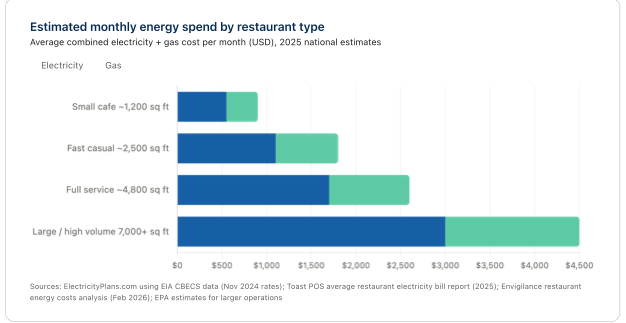
Typical monthly utility spend | $2,000 to $6,000 for most restaurants; larger or more equipment-intensive operations run higher |
Electricity price increase, 2025 | 6.9% year-over-year — more than double the 2.9% CPI rate (Goldman Sachs) |
Potential savings from operational and low-cost efficiency measures | Roughly 10% to 30%, depending on current practices and equipment condition |
Untapped commercial efficiency opportunity (U.S. average) | 76% of available energy savings go uncaptured by the typical U.S. utility's commercial programs (BlastPoint / Utility Dive, May 2026) |
Translated into dollars: a restaurant spending $4,000 per month on energy would save $7,200 per year from a 15% reduction. That kind of savings does not require selling more meals, raising menu prices, or cutting service quality.
The Opportunity Your Utility Isn't Chasing For You
A May 2026 analysis by BlastPoint, published in Utility Dive, found something striking: the typical U.S. electric utility captures only 23.8% of the commercial energy efficiency savings available in its service territory. For every four kilowatt-hours a business could be saving, the utility's programs help recover one. Three go untapped.
The analysis studied 286 utilities and found that 57 of them are helping their commercial customers save less than 5% of what's actually available. The gap isn't because the savings aren't real — it's because the programs to capture them aren't being deployed at scale.
For restaurant operators, this matters in two specific ways. First, utility rebate and incentive programs for commercial efficiency upgrades exist and are often underutilized — especially for refrigeration, HVAC, and lighting. Second, as data centers drive the strongest growth in U.S. electricity demand since 2000, utilities are under pressure to find low-cost solutions. Commercial efficiency is the cheapest tool available to limit new generation needs — at a median cost of $21 per megawatt-hour, less than half the cost of building new generation (ACEEE, February 2026). That pressure creates a window: operators who act now can often access incentive dollars that will become more competitive as programs scale.
The practical implication is simple: don't assume your utility has already flagged you for available savings. Most haven't. An independent review of what's on the table in your market is almost always worth doing.
Where the Waste Lives
The highest-impact areas in most hospitality operations tend to fall into five categories.
Refrigeration
Refrigeration is often one of the largest single energy loads in a restaurant. Compressor performance, condenser cleanliness, door seals, temperature calibration, and maintenance discipline all influence how hard the system works. According to EIA commercial building data, refrigeration accounts for roughly 32% of a restaurant's total electricity consumption — making it the single biggest controllable variable in most operations.
HVAC
HVAC drives about 28% of restaurant electricity use. Systems without programmable controls, zoning, or occupancy-aware scheduling often run longer and harder than needed. The guest-facing consequence of poor HVAC management is real: inconsistent temperatures are among the most common comfort complaints in full-service dining environments. Getting HVAC right reduces cost and complaint volume simultaneously.
Kitchen equipment behavior
Fryers, ovens, broilers, and ranges are frequently turned on too early and left on too long. Simple changes in preheat timing, shutdown discipline, and sequencing during slow periods can reduce wasted load without affecting throughput. This is a behavior and scheduling problem as much as an equipment problem — which means it's often solvable without capital.
Lighting
Lighting upgrades are among the least disruptive efficiency improvements available. Switching from older fixtures to LEDs can reduce lighting electricity use by up to 75%, according to industry data, and often delivers one of the fastest payback periods in the building. The ambiance benefit compounds the financial one: tunable LED systems give operators control over the guest environment in ways older lighting systems simply don't allow.
Water heating
Water heating can be improved with low-cost operational changes. Low-flow pre-rinse spray valves are widely recommended because they cut both hot-water use and the energy required to heat that water — with payback periods measured in months, not years.
Rate Structure and Market Exposure
In deregulated electricity markets, suppliers compete for commercial customers, and contract structure matters. Seventeen states plus the District of Columbia are fully or partially deregulated for retail electricity choice, including Texas, New York, Pennsylvania, Ohio, Illinois, and others.
Risk rises when a restaurant's highest usage lines up with expensive grid hours, or when the business is on a poorly structured supply contract. The opportunity is that fixed-rate contracts, indexed products, usage management, and supplier competition can all lower exposure when reviewed strategically.
Operators don't need to become energy traders. They do need to know what kind of contract they're on, how pricing is set, when demand peaks occur, and whether a better product is available in their market. Most have never checked.
Measurement Before Capital Spending
The first practical step is not replacing equipment. It's measurement. Operators who track food cost to the tenth of a point often have no visibility into which assets or operating windows are actually driving the utility bill.
Smart meters, submetering tools, and building-energy monitoring platforms have become easier to deploy and more useful for small and mid-sized operators. They turn energy from a fixed overhead line into a measurable operating variable that can be improved over time.
An energy audit provides the baseline. After that, the highest-return next steps — behavioral, contractual, maintenance-related, or capital-intensive — become much easier to prioritize. And with 76% of commercial efficiency opportunity sitting uncaptured in the average utility's territory, the baseline often reveals more low-hanging fruit than operators expect.
A Practical Action Plan
For most hospitality operators, a phased plan delivers results without operational disruption.
Immediate actions — no capital required
• Review your energy contract and rate structure to understand costs.
• Develop an equipment on/off schedule and assign shift managers for accountability.
• Regularly inspect refrigeration seals, clean condenser coils, and replace HVAC filters.
• Explore utility incentive programs, as many rebates go unclaimed.
Short-term upgrades — low capital
• Upgrade to LED fixtures for better ambiance and efficiency.
• Install low-flow pre-rinse spray valves.
• Add programmable thermostats or smart HVAC controls where possible.
• Use monitoring tools to identify waste patterns.
Medium-term investments — strategic
• Replace old refrigeration or HVAC systems with high-efficiency models.
• Consider fixed-rate or indexed electricity options in areas with retail choice.
• Include utility rebates and incentives in the investment plan for equipment upgrades.
The Bottom Line
Profitability in hospitality isn't only about filling more seats or raising average check. It's about closing the gap between what the business earns and what quietly leaks away.
Energy sits in that gap for most operators. It's visible enough to notice, poorly measured enough to ignore, and significant enough that the operators who close that gap tend to protect margins in ways that compound over time — through lower operating costs, better-maintained equipment, and a guest environment that earns repeat business.
The operators who will be best positioned through the next several years of rate pressure aren't necessarily the ones with the newest equipment or the biggest capital budgets. They're the ones who decide to treat energy the same way they treat food cost and labor: as a managed, measured, and improvable variable.
That starts with knowing what you're spending, understanding what's driving the bill, and building a plan that improves efficiency, pricing, and equipment decisions over time.
Ready to find out where your energy dollars are going?
Red Shield Consulting offers energy invoice audits, contract review, utility-cost strategy, and equipment planning for hospitality businesses that want to reduce avoidable utility spend and protect margins in a volatile market. A clear energy baseline reveals where costs are rising, where waste is hiding, which utility incentives are available, and which actions are most likely to pay back first.
Contact us to schedule a conversation.
Sources
• Goldman Sachs research note: electricity prices jumped 6.9% in 2025 YoY (February 2026)
• American Customer Satisfaction Index (ACSI) Restaurant and Food Delivery Study 2025
• Kiosk Industry / NRA State of Restaurant Industry 2025: 9 in 10 consumers cite experience as driver
• BlastPoint / Utility Dive: typical U.S. utility captures 23.8% of available commercial C&I savings (May 27, 2026) — eeindex.blastpoint.com
• American Council for an Energy-Efficient Economy (ACEEE): utility EE programs save electricity at median $21/MWh, vs. $40+/MWh for new gas generation (February 2026)
• U.S. EIA / E Source: refrigeration ~32%, HVAC ~28% of restaurant electricity consumption
• Action Services Group / DOE: LED lighting uses up to 75% less energy than incandescent (2025)
• Rezku Blog: 83% of restaurants cited energy/utility costs as a significant challenge in 2024
• ElectricityPlans.com / EIA CBECS: average commercial electricity rate 12.22¢/kWh (Nov 2024)
• Envigilance: 25–40% of restaurant energy spend is waste (February 2026)


Comments